Yuwei Wu

Yuwei Wu

I'm a final-year Ph.D. candidate in Electrical and Systems Engineering at the University of Pennsylvania and a member of the General Robotics, Automation, Sensing, and Perception (GRASP) Laboratory, advised by Prof. Vijay Kumar. Before my doctoral research, I worked with Prof. Fei Gao at Zhejiang University on trajectory optimization for quadrotors.

My research focuses on safe and efficient robot autonomy in complex environments, with a focus on planning methods that exploit the dynamics, geometry, and interactions of real robotic systems. My work has appeared in IEEE RA-L, T-ITS, T-ASE, ICRA, IROS, MRS, WAFR, and DARS, with recognition including IROS 2025 Best Paper Award Finalist, Best Paper Award nomination at DARS 2024, and Oral Highlight at the ICRA 2025 Doctoral Consortium. I contribute to the broader robotics community as Associate Editor for IEEE Robotics and Automation Letters (RA-L), Guest Editor for Autonomous Robots, student representative on the IEEE Technical Committee on Aerial Robotics and Unmanned Aerial Vehicles, and organizer of workshops at RSS and IROS. I have also reviewed more than 100 submissions across over 10 leading robotics journals and conferences.

I am currently on the 2026-27 job market!


Recent News:
  • [Aug. 2026] I was appointed as an Associate Editor of IEEE RA-L.
  • [Jun. 2026] Two papers were accepted to IROS 2026.
  • [Jun. 2026] Our workshop on Tightly Coupled Physical Interaction and Collaboration in Multi-Robot Systems was accepted to IROS 2026.
  • [Jun. 2026] Our WAFR paper was featured at GRASP News "Geometric optimization frameworks for safe, real-time trajectory generation"
  • [May. 2026] Our MIGHTY project was featured in several news, including Penn Today, DroneXL.co, MIT News, and GRASP Lab News
  • [May. 2026] Our RA-L paper titled "Towards Optimizing a Convex Cover of Collision-Free Space for Trajectory Generation" was presented at ICRA 2026.
  • [Apr. 2026] Our paper titled "STAR-Filter: Efficient Convex Free-Space Approximation via Starshaped Set Filtering in Noisy Environments" was accepted to WAFR 2026.
  • [Mar. 2026] I am honored to serve as a student representative on the IEEE Technical Committee on Aerial Robotics and UAVs for the 2026-2027 term.
  • [Mar. 2026] Our work with Kota Kondo and Prof. Jonathan P. How, titled "MIGHTY: Hermite Spline-based Efficient Trajectory Planning", was accepted to IEEE RA-L.
  • [Jan. 2026] Presented a poster at Robotics Gordon Research Conference: Embodied Intelligence in Robots and Animals.
  • [Nov. 2025] One paper was accepted to IEEE T-ASE.
  • [Oct. 2025] I was invited to chair the session “Intelligent and Safe Autonomy for Aerial Systems” under the Air Transportation Section (ATS) track. at the INFORMS 2025.
  • [Oct. 2025] I was referred by TILOS to present a poster at the Summit for AI Institutes Leadership (SAIL) 2025
  • [Sep. 2025] Two papers (1, 2) were accepted to the IEEE MRS 2025.
  • [Sep. 2025] I gave a talk at RGSO - CARS Seminar, University of Delaware titled “Building Resilient and Efficient Robot Autonomy.”
  • [Jun. 2025] One paper was accepted to IEEE/RSJ IROS 2025 (Best Paper Award Finalist).
  • [Jun. 2025] I presented our work titled "Learning Riemannian Polynomials for 3-D Rigid Body Motions" at the TILOS 2025 Industry Day .
  • [Apr. 2025] My work has been selected for Oral Highlights at the IEEE ICRA 2025 Doctoral Consortium.
  • [Apr. 2025] I gave a talk on Flying Robot Swarms at Roxborough Library, "Fun With Robots" program.
  • [Mar. 2025] Our workshop Leveraging Implicit Methods for Aerial Autonomy was accepted to RSS 2025.
  • [Mar. 2025] I gave a talk at the ESE Ph.D. Colloquium titled “Real-Time Spatiotemporal Motion Planning for Autonomous Robots.”
  • [Mar. 2025] One paper was accepted to IEEE RA-L.
  • [Jan. 2025] Two papers were accepted to IEEE ICRA 2025.
  • [Nov. 2024] Presented a demo featured in PHL17 News covering our drone research.
  • [Jun. 2024] ROS and Open Robotics featured our open-source work in a post on X.
  • [Sep. 2024] Our RA-L paper was presented at IEEE ICRA@40.
  • [Sep. 2024] One paper was accepted to DARS and nominated for the DARS Best Paper Award.
  • [Jul. 2024] I presented our work titled "Finding Trajectory-Optimal Convex Cover in a Cluttered Environment" at the TILOS 2024 Industry Day .
  • [Jun. 2024] One paper was accepted to IEEE/RSJ IROS 2024.
  • [Apr. 2024] I gave a talk on How robots find their way at Roxborough Library, "Fun With Robots" program.
  • [Jan. 2024] One paper was accepted to IEEE RA-L and one paper was accepted to IEEE ICRA 2024.
  • [Jun. 2023] I presented our work titled "Learning Time-Optimal Minimum Control Trajectory for Quadrotors" at the TILOS 2023 Industry Day .
  • [Jan. 2023] Passed my qualifying exam and advanced to Ph.D. candidacy.
  • [Jan. 2023] One paper was accepted to IEEE ICRA 2023.
  • [Sep. 2022] I presented our work at CBRIC 2022 Annual Meeting.
  • Show more ↓

Research taxonomy


Central question: How can we identify the right level of abstraction to reduce complexity while preserving the essential structure needed for robot motion planning and decision-making?

I study how robot motion and trajectory planning problems can be formulated so that their underlying physical structure is easier to exploit computationally. I develop optimization-based methods that preserve feasibility and safety while reducing planning complexity, and use learning to improve representations and accelerate solution procedures. Foundation models provide higher-level reasoning, with optimization grounding their outputs in the constraints of real robotic systems.

Physical abstractions for learning and optimization

Physical abstractions for learning and optimization

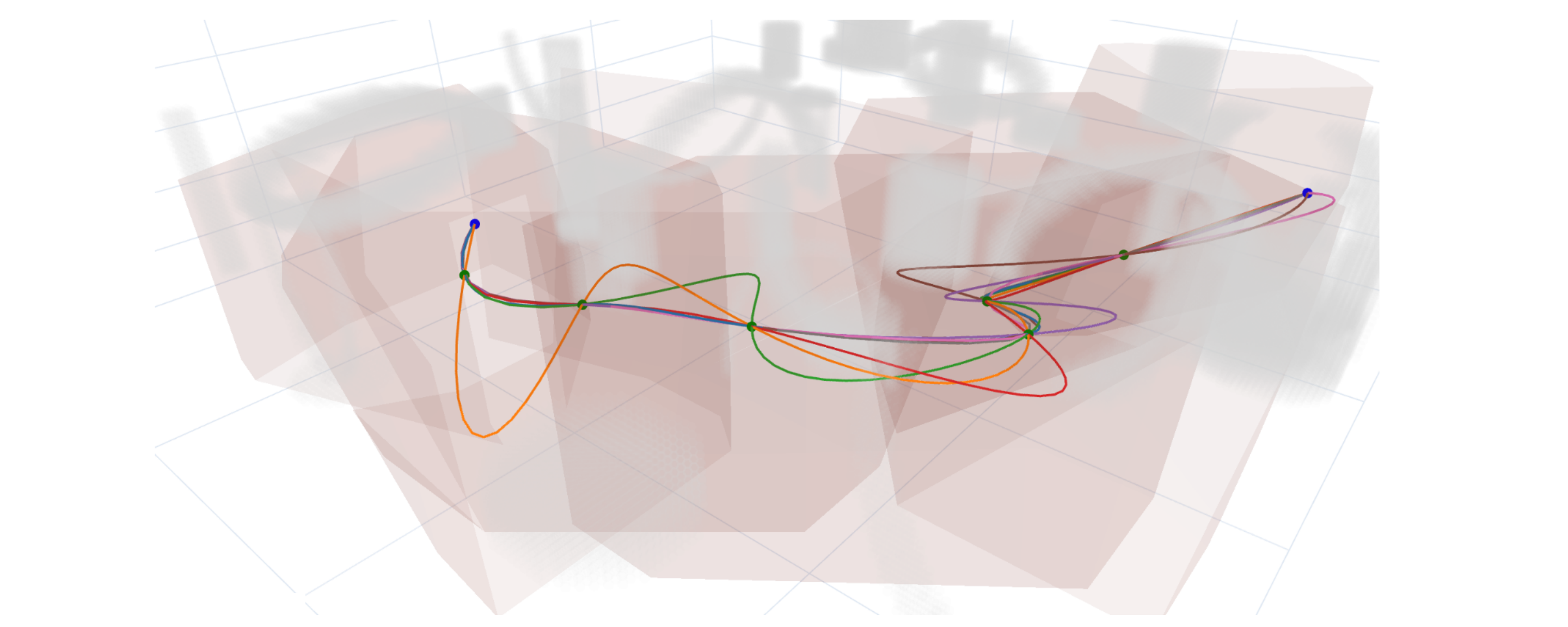
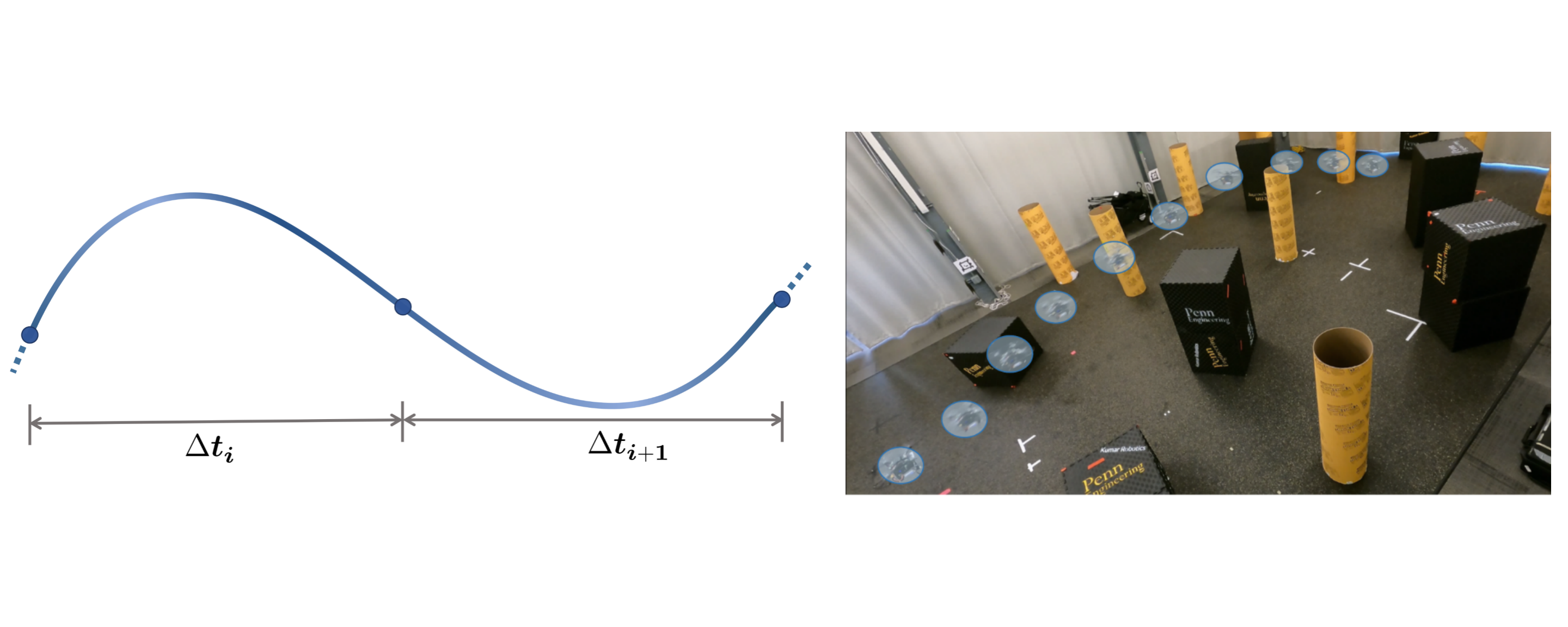
Planning dynamically feasible motion over long horizons is difficult in high-dimensional systems. I use physically grounded abstractions, including differential-flatness outputs and piecewise-polynomial parameterizations, to optimize scalable, high-fidelity trajectories.

Geometric reduction for scalable environmental representation

Geometric reduction for scalable environmental representation

Robots collect dense, noisy spatial data, but only a small subset determines whether a motion is feasible. I develop real-time algorithms that turn point clouds and obstacle measurements into compact geometric and spatiotemporal representations for safe and efficient planning.

Semantic representations in multi-agent and foundation models

Semantic representations in multi-agent and foundation models

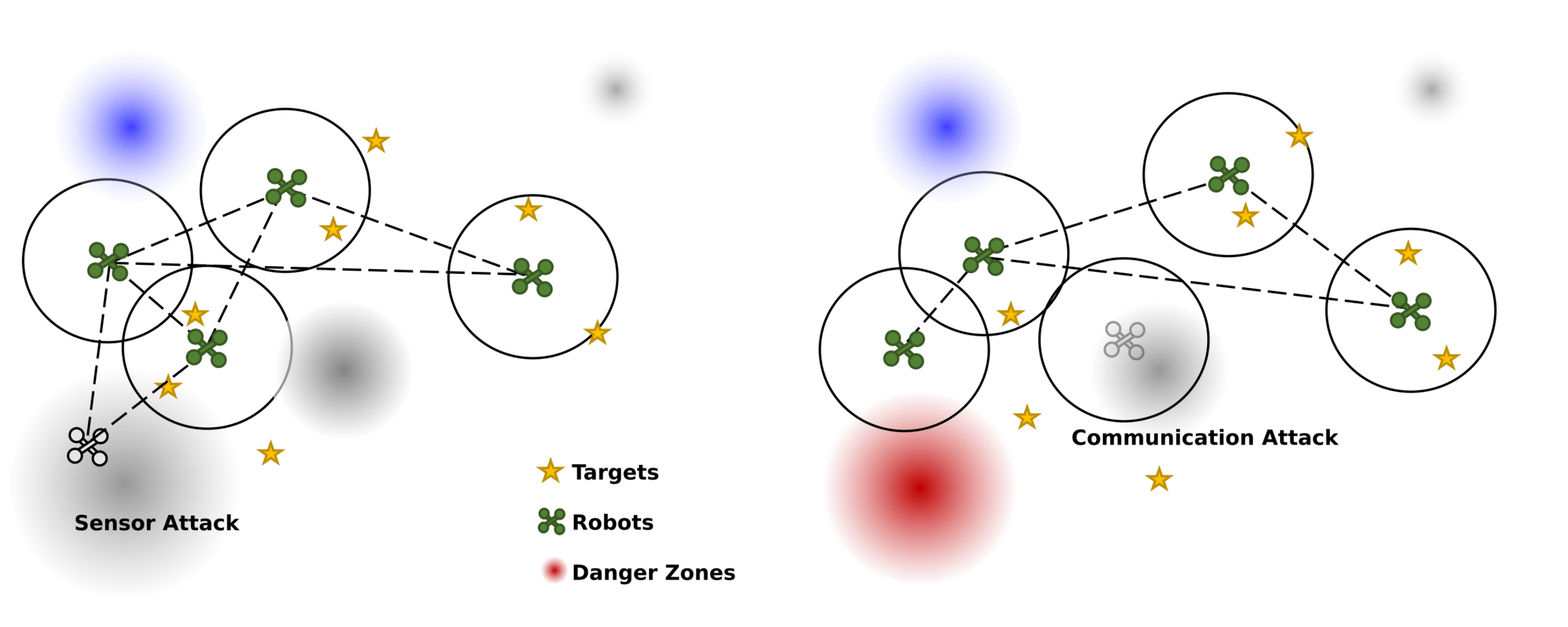
Foundation models can support robot decision-making, but their outputs must be grounded in physical feasibility, robot capabilities, and multi-agent constraints. I translate language and feedback into structured operators, programs, optimization objectives, and geometric constraints for verifiable robot execution.


Falcon4 model adapted from Kumar Robotics' mrsl_quadrotor repository; license and attribution.